
Here is a question that, on the evidence of how rarely it is asked in public, the British insolvency industry would prefer remained unexamined.
When a UK company director walks into a meeting with an Insolvency Practitioner to discuss the future of their business, whose financial interests are being served by the conversation that follows?
The director’s, in theory. The director, after all, is the one in the room with something to lose. The director is the one whose company, livelihood, personal guarantees, and in many cases family home are on the line. The director is, formally, the client.
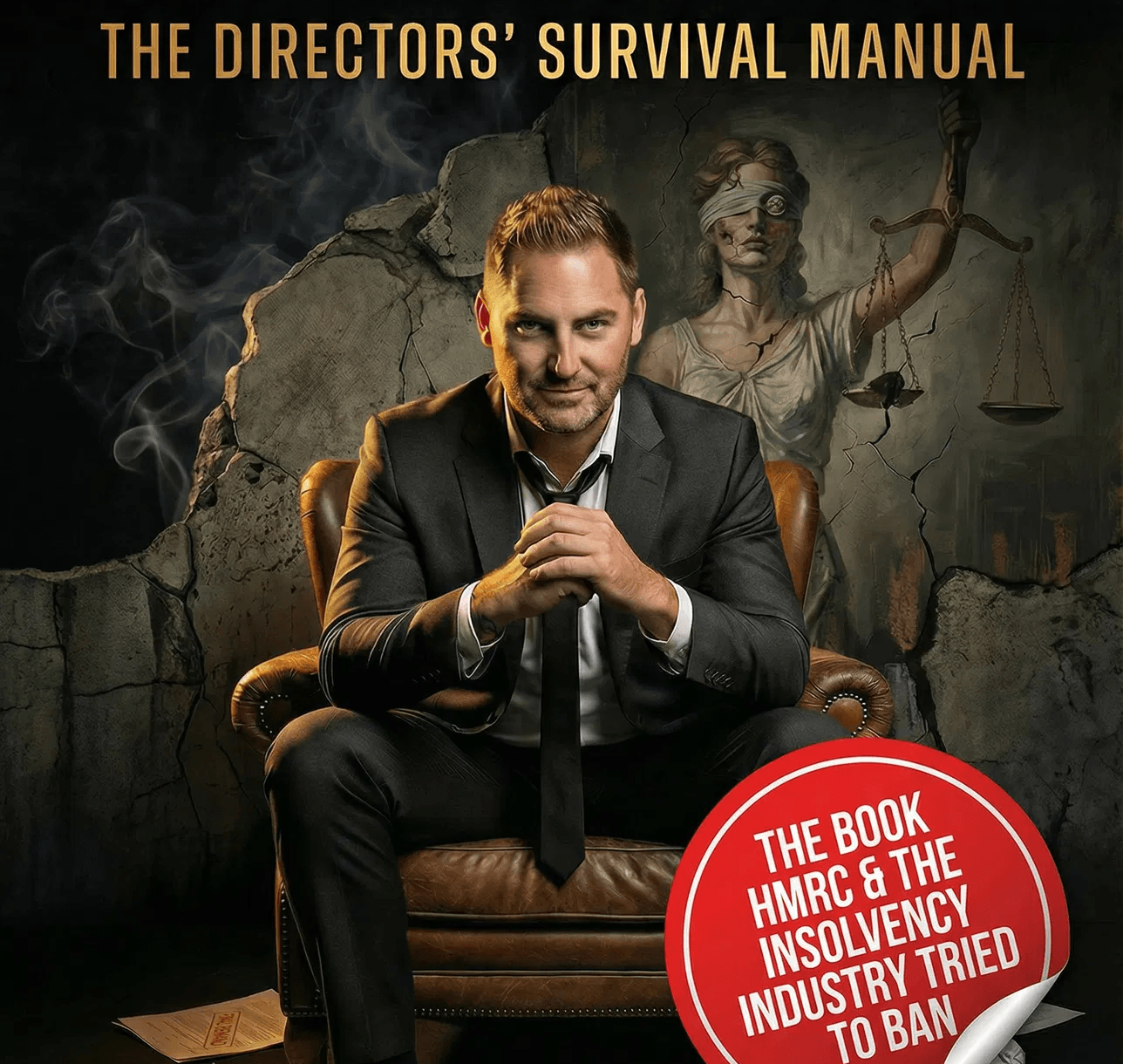
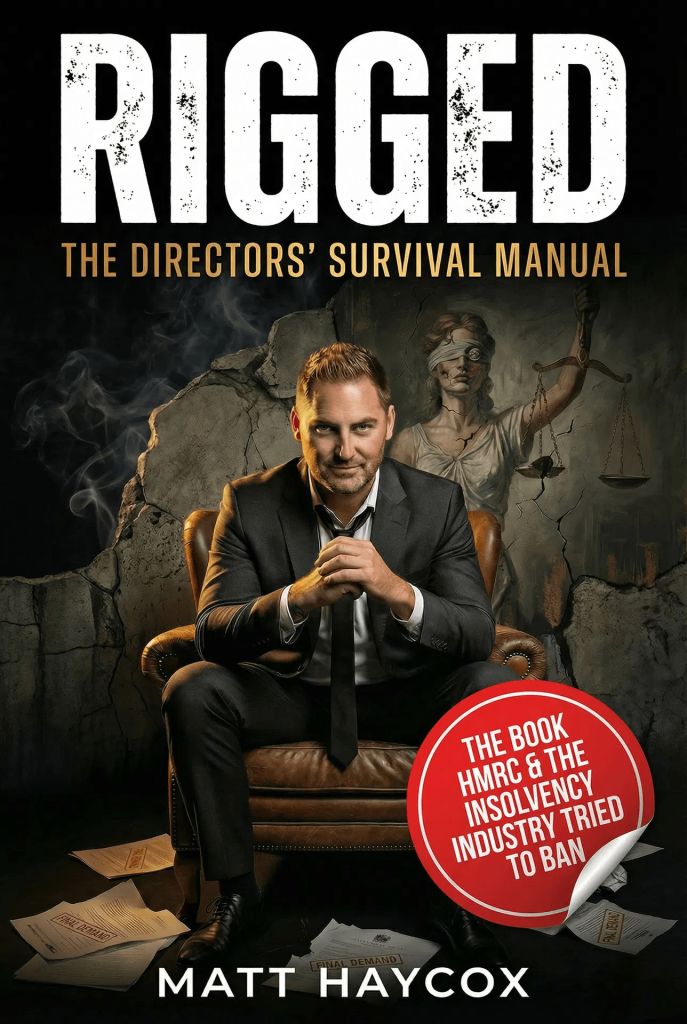
In practice, according to the entrepreneur Matt Haycox, the answer is rather less reassuring. And it is the central charge of his new book, RIGGED: The Directors’ Survival Manual, that the British insolvency system is structured around a set of financial incentives that systematically reward the destruction of companies over their rescue — and that the directors sitting on the wrong side of those incentives almost never understand, in real time, that the conversation they are having is not the one they think it is.
“The system isn’t broken,” Haycox says. “It’s working exactly as designed — it’s just not designed to help you.”
The Fee Structure Nobody Discusses
The mechanics of the argument are not, on inspection, especially complicated. They are simply not widely discussed outside the profession, and they are almost never explained to directors in advance of the decisions that depend on them.
An Insolvency Practitioner appointed over a company in financial difficulty earns fees in different ways depending on which procedure is pursued. A full liquidation — particularly a Creditors’ Voluntary Liquidation, where the practitioner takes control of the company’s assets, realises them, and distributes the proceeds — generates substantially more fee income than a Company Voluntary Arrangement, in which the company continues trading and pays creditors a portion of what is owed over an extended period.
The practical difference, on any given case, can be considerable. Liquidations generate work. They generate asset realisations. They generate creditor meetings, statutory reporting, investigations into directors’ conduct, and a long tail of administrative activity that, billed at hourly rates, can add up to significantly more than the fixed-fee or success-based arrangements typical of a CVA.
This is not a secret. It is, in fact, a standard feature of the fee structures that govern UK insolvency work. What is not standard is the practice of explaining it, in plain English, to the director sitting across the table at the moment they are being asked to choose a route.
“Your Insolvency Practitioner earns more when your company dies,” Haycox writes in RIGGED. “That’s not a conspiracy. That’s their fee structure. Read the engagement letter.”
The Referral Economy
The fee structure is one half of the conflict-of-interest argument. The other half, and arguably the more consequential half, concerns how directors arrive at the Insolvency Practitioner’s office in the first place.
In the overwhelming majority of cases, they are referred. Usually by their accountant. Sometimes by their bank’s relationship manager. Occasionally by a solicitor. The introduction is framed, almost always, as a recommendation made in the director’s interest — somebody the adviser knows, somebody the adviser trusts, somebody who has handled difficult cases before.
What is rarely framed, and rarely disclosed in any detail the director understands, is the existence of a parallel financial relationship running underneath the referral. Many accountants maintain ongoing professional relationships with specific Insolvency Practitioners. Some of those relationships involve formal referral arrangements. Some involve informal expectations of reciprocal work. Some involve nothing more than a long pattern of mutual professional benefit that, while not contractually documented, has the same practical effect.
The director, in most cases, is told none of this. They are told only that they should speak to “somebody we work with.”
“By the time you’re sitting in front of an Insolvency Practitioner,” Haycox says, “you’re already inside a referral chain. Your accountant didn’t pick that person at random. Your accountant picked that person because they have a relationship. And nobody has told you what that relationship is, because nobody benefits from you knowing.”
It is, on his account, the single most consistent failure of disclosure in the entire system. Directors who have spent years assuming their accountant is acting purely as their adviser discover, often only after the fact, that the chain of professional relationships running through their financial collapse was considerably more interlocking than they had been led to believe.
The Options Not Mentioned
The third strand of the conflict-of-interest argument, and the one that has caused the most discomfort within the profession since RIGGED began circulating, concerns what directors are told about their options.
UK insolvency law provides a reasonable range of procedures for a company in financial difficulty. Company Voluntary Arrangements, in which the company continues trading and pays creditors a negotiated portion of what is owed. Administration, in which a moratorium on creditor action allows time to restructure or sell the business as a going concern. Pre-pack administration, in which a sale is negotiated in advance and executed at the point of appointment. Informal arrangements with creditors. Time to pay agreements with HMRC. Refinancing. Restructuring. And, where genuinely appropriate, liquidation.
None of these options is obscure. All of them are part of the standard professional toolkit. And yet, on the evidence of reader feedback to RIGGED, directors are routinely presented with a menu that has been narrowed, often without explanation, to a single dish.
“Most directors are told one option,” Haycox says. “Sometimes two. They’re rarely told all of them, because the person doing the telling doesn’t benefit from them understanding the full picture. If liquidation generates the biggest fee, liquidation is what gets presented as inevitable. If a CVA would have saved the company but generated a tenth of the fee income, the CVA never comes up.”
He is careful, in both the book and in conversation, not to characterise the entire profession in these terms. There are, he readily acknowledges, good Insolvency Practitioners who present the full range of options honestly and recommend the path that best serves the director’s interests rather than their own fee income.
“I’m not anti-Insolvency Practitioner,” he says. “I’m anti-bullshit. The problem isn’t the individuals. The problem is a system where the default outcome benefits the adviser more than the advised, and where the regulatory framework hasn’t caught up with the conflicts that creates.”
What the Industry Has Not Said
What is striking about the reception of RIGGED, in the months since it began circulating through the UK director community, is what has not happened.
No professional body has issued a substantive rebuttal. No trade publication has run a detailed defence of the fee structures the book describes. No senior figure in the industry has engaged, in public, with the specific claims about referral economics and option presentation. The discomfort the book has generated within the profession is real, but the response has been overwhelmingly private — back-channel conversations, off-the-record warnings, the occasional muttered complaint at industry events.
Haycox is not surprised. He is, in many ways, banking on it.
“If the industry wants to argue the points, they can argue the points,” he says. “The book is out. The arguments are in writing. If somebody wants to publish a rebuttal explaining why a fee structure that pays more for liquidation than rescue doesn’t influence behaviour, I’d genuinely like to read it. I’m not holding my breath.”
It is a posture that has earned him a certain amount of enmity within the profession, and a considerable amount of gratitude from the directors who have read the book. Published through his platform Insolvency World, the 200+ page volume is positioned explicitly as the resource Haycox wishes had existed when he himself sat across a table from an Insolvency Practitioner, in the middle of his own personal collapse, and did not know what questions to ask. Directors and business owners can also find more of Haycox’s wider business commentary, interviews and entrepreneurial resources on Matt Haycox’s official website
The book is, in many ways, the questions he wishes he had known to ask. And it is, for a profession that has spent decades operating in the quiet space between formal compliance and informal incentive, an awkward kind of document to have in circulation.
The Question That Remains
Whether RIGGED ultimately moves the needle on UK insolvency practice is a question for a longer timeframe than this one. The industry is large. The fee structures are entrenched. The regulatory machinery moves at its own pace, and the lobbying power of the profession is not negligible.
But the underlying question the book poses is one that the industry has not yet found a satisfactory way to answer in public. If the people meant to advise a director in financial difficulty are paid more when that director’s company is destroyed than when it is saved, and if the people referring directors to those advisers have undisclosed financial relationships with them, and if the full menu of options is routinely narrowed before it ever reaches the director’s ears — then the description of the system as one structured around an inherent conflict of interest is not a polemic.
It is a description.
“Nobody tells you this stuff,” Haycox writes in the closing chapters of RIGGED, “because nobody benefits from you knowing it. Except you.”
It is, in the end, the single most important sentence in the book. And it is the one the industry has, so far, conspicuously declined to answer.