A team of archaeologists have uncovered a Roman stone coffin weighing the same as a small caravan.
The casket, which weighed 118 stone (750kg), was discovered during National Highways’ work to transform a section of a road from a single to a dual carriageway on the A47, between Wansford and Sutton, near Peterborough.
Over a seven-month period, a team of 52 archaeologists and 20 civil engineers worked on 12 sites on a section of the A47, with specialist support from the Museum of London Archaeology, York Archaeology, Heritage 360, CR Conservation and Clivedon Conservation.
READ MORE: Brits are choosing more than just the slopes as they admit to taking ski trips for the ‘scenery’
The 1,500-year-old artefact dates back all the way to Britain’s Roman Era.
It is believed to have been hand-carved from a single solid block of limestone.

The burial inside was encased in gypsum before capping stones were placed on the coffin.
This process involves pouring liquid gypsum over the individual which then sets to form a hard cast.
This cast can often preserve an imprint of the individual, moulding around them and their clothing or burial shroud.

While it isn’t known exactly who lay inside the coffin, its fine craftwork and the gypsum would have been expensive.

Due to this, it is believed that the box held somebody of high status.
Project manager David Harrison, from Headland Archaeology, called it a “fascinating discovery”.
One image shows the coffin as it was discovered.
Another shows it shortly after it was lifted out of the earth, as reported by Need To Know.

There are also images of leather, pottery and animal bones which were recovered nearby.
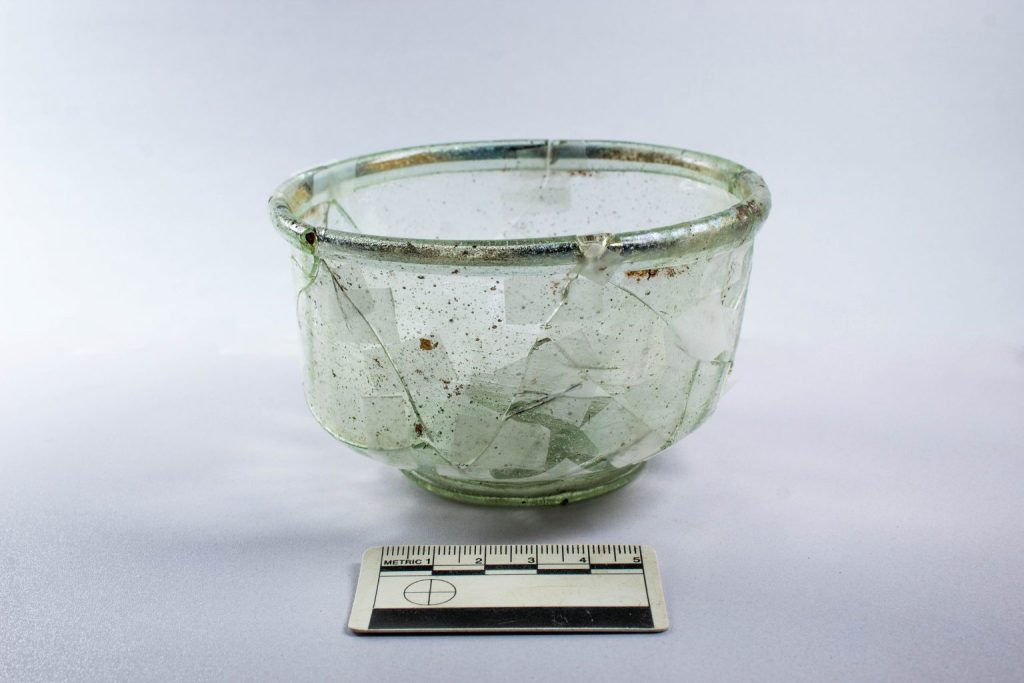
The glass vessel could have once held a toast or libation for the deceased before it was placed in the grave.
In another grave, archaeologists found a beautiful pair of silver earrings, nine copper alloy bracelets, three copper alloy rings and a silver band and oval plate, thought to be the shank and bezel of a signet ring.

“The archaeology and heritage work to support the A47 dualling scheme has involved physical excavation and geophysical surveying,” Mr Harrison said.
“The stone coffin and its fragile contents together weighed 750kg, which made safely removing it from the site a challenge.

“Doing so with care to keep it in one piece was even more important due to the structure containing significant fractures.
“Owing to the situation’s complex nature, the team collaborated with conservation specialists to uplift the coffin and excavate it in a controlled environment to ensure its preservation.
“Of the archaeology excavated so far, a small Roman roadside cemetery is of particular interest.

“The cemetery contained several fascinating artefacts and evidence of an elaborate burial practice not previously known in the east of England – a Roman gypsum burial in a finely carved limestone coffin.”
READ MORE: Angry thug swings at bus driver in ticket row as stunned OAP passengers watch on