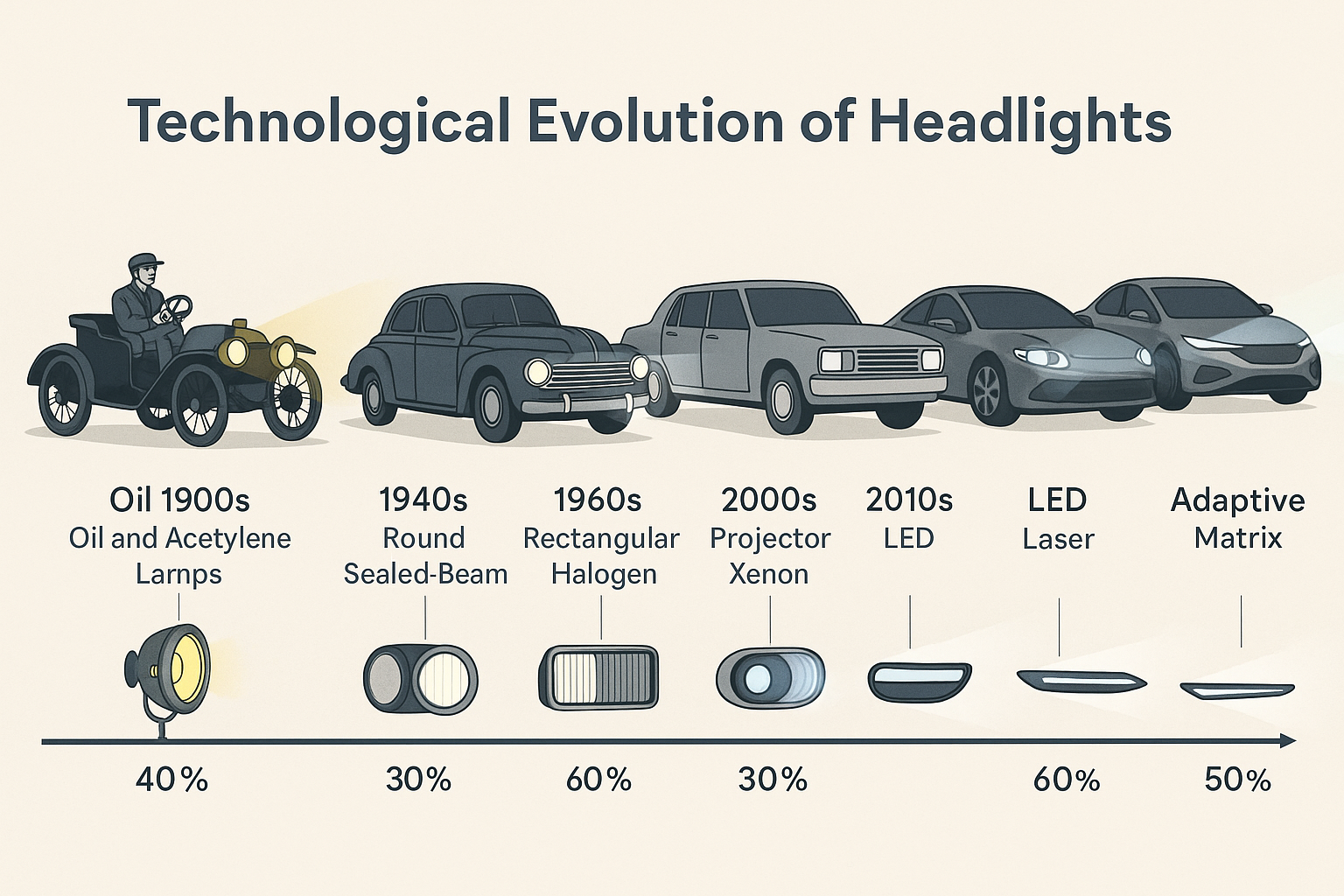

From spinning lights to laser-powered beams, car headlights have undergone some truly strange experiments. These unusual designs pushed the boundaries of both style and function, creating automotive icons that still fascinate enthusiasts today.
Car headlights do far more than just light the road ahead. They’re the eyes of a vehicle, giving each model its unique personality and character. Over the decades, designers have experimented with increasingly bold approaches to automotive lighting, resulting in some genuinely bizarre creations that either became legends or cautionary tales.
The pioneer with three eyes – Tucker Torpedo
The Tucker 48, often called the Tucker Torpedo, featured perhaps the most unusual headlight setup ever: three lights instead of the traditional two. The most recognizable feature was a third directional headlamp, centrally located, which would activate at steering angles of greater than 10 degrees to light the car’s path around corners. This “Cyclops eye” was revolutionary for 1948, though the concept wasn’t entirely new – a small Massachusetts automaker had offered similar swivel headlights on its Beverly Touring Car 44 years earlier in 1904.
At the time, 17 states had laws against cars having more than two headlights, so Tucker fabricated a cover for the center light for use in these states. Only 51 of these ambitious cars were ever built, making surviving examples extraordinarily valuable today.
The rolling revolution – Opel GT
Pop-up headlights became common in the 1970s and 80s, but the Opel GT took a completely different approach. At first glance, the Opel GT headlights look like a set of large but normal pop-ups. However, rather than just popping up from the front, Opel went with a weird design to have them roll over from the side. No matter how many times you see it happen, the effect is always disconcerting.
This unusual rotating mechanism made the GT stand out from every other sports car of its era, creating an almost theatrical display whenever the driver switched on the lights.
The multiple pop-up madness – Cizeta V16T
Pop up headlights are cool, so more pop up headlights must be cooler, right? The V16T is the only car the Cizeta-Moroder company made and as the name suggests, is powered by a V16 engine. This supercar featured not two, but four individual pop-up headlights – a perfect example of 1990s excess that matched its massive V16 engine.
The design was innovative, expected for a mid-engined V16 supercar. There were only 20 made in the first production round, even though the car began production again in 2006.
The nightmare face – Nissan Juke
Not all bizarre headlight designs aged well. The Nissan Juke is widely despised for its looks, and part of that is in how the headlights are set with the grill shaped over them, while the sidelights are mounted high with the hood. The effect causes the Juke’s face to make no sense – in the same way that a photo of someone having two extra eyes above their eyebrows would be upsetting.
This arrangement completely confused traditional automotive “face” proportions, creating what many considered one of the most unsettling front-end designs ever produced.
The glass-encased innovation – Citroën SM
The Citroën SM showcased a completely different approach to unusual headlight design. The headlights of the car were just as cool as the rest of the vehicle as they were encased in glass, which is a very unique design feature. The number plate was also encased in glass at the front of the car, producing a very smooth and futuristic design.
After 12 years on sale, the ‘Goddess’ was given quad headlamps with a self-levelling function and – more importantly – the ability to swivel up to 80deg to follow the car’s steering arc. This combination of glass housing and steering-linked movement created one of the most sophisticated headlight systems of the 1970s.
The pop-up era’s golden years
The late 1970s through early 1990s marked the golden age of pop-up headlights. As a child of the 1980s who came of age in the early ’90s, pop-up headlights are, in my mind, the peak of automotive cool. All the raddest, most interesting cars of my childhood — Lamborghinis, Starions, Trans-Ams, Fieros — had pop-ups. These retractable lights allowed designers to create smooth, aerodynamic shapes while meeting safety regulations.
The Numbers Behind the Pop-Up Phenomenon
The statistics tell the remarkable story of pop-up headlights’ rise and fall. The 1980s represented the absolute peak of pop-up headlight production, with more cars featuring them in that decade than any other. Everything from exotic supercars to mainstream family cars like Honda Accords embraced the design. The Ferrari F40 saw just 1,315 units produced between 1987-1992, while the more accessible Mazda MX-5 Miata became the world’s best-selling two-seater sports car, with over one million examples produced – many with the iconic pop-up design.
However, by the late ’90s pop-ups were pretty much only found on sports cars and exotics. Then, in 1998, an EU mandate regarding pedestrian safety regulations essentially killed pop-ups in Europe. The last time pop-up headlamps appeared on a volume-production car was in 2004, when both the Lotus Esprit and Chevrolet Corvette (C5) ended production – marking the end of an era.
The monster grilles – Bugatti’s artistic eyes
Modern supercars have pushed headlight design into artistic territory. When it comes to drama, Bugatti always manages to take things up a notch. The Galibier’s LED headlights are an intricate design that gets as close to the eye metaphor as possible. At night the headlights seem to stare at you in cold, menacing, calculation. If there was an example of headlights as art, this is it.
While discussing unusual designs, it’s worth noting that even everyday cars like the Corsa D Headlight should be checked regularly for proper function and alignment, as these basic maintenance tasks can prevent both safety issues and costly repairs.
The future of bizarre design
The second generation of the Audi R8 was launched in 2015 and the headlights are available as laser headlamps in Europe, making the car extremely cool. As LED and laser technology advances, we’re seeing headlights become increasingly sculptural and dramatic.
Market Growth and Innovation
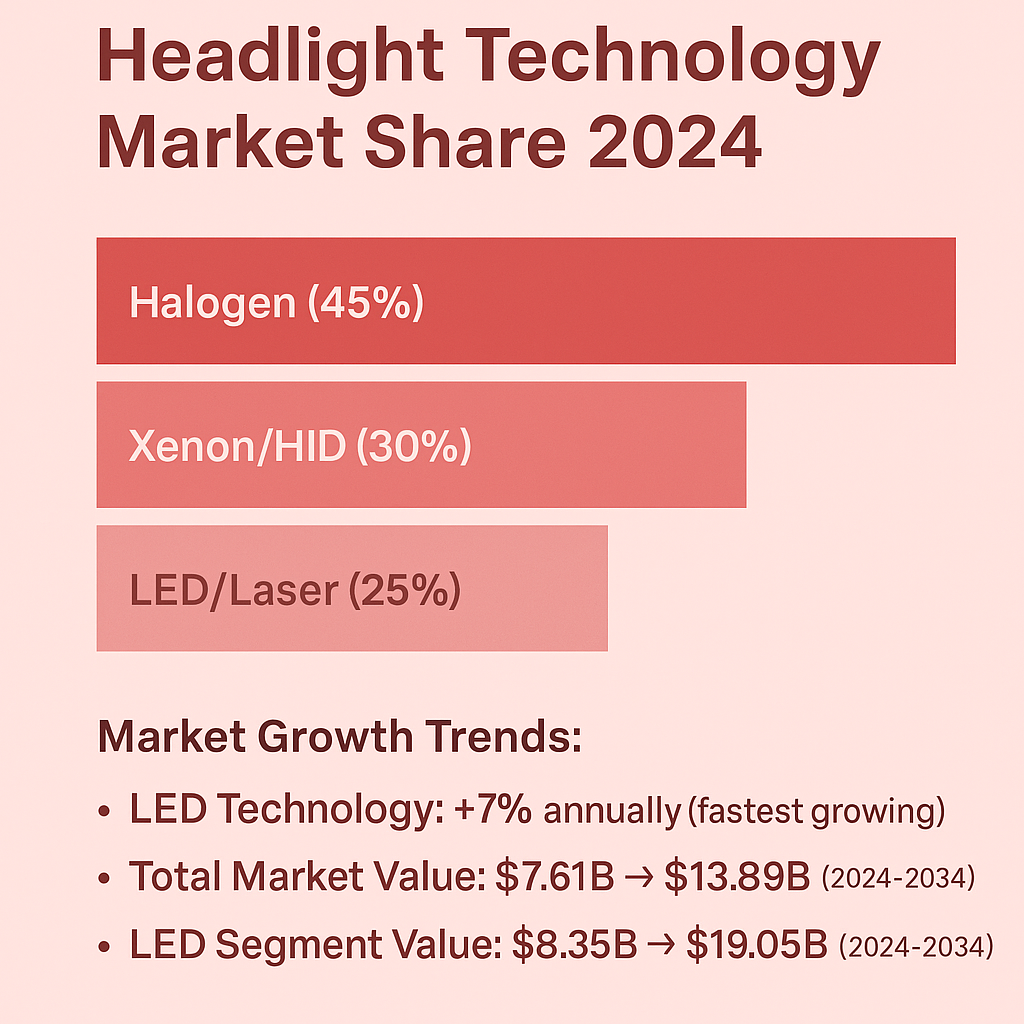
The global headlight market reflects this innovation trend, with values reaching $7.61 billion in 2024 and expected to grow at 6.20% annually to reach $13.89 billion by 2034. LED technology is driving much of this growth, with automotive LED lighting markets expanding from $8.35 billion in 2024 to a projected $19.05 billion by 2034. This represents a significant shift from traditional halogen systems to more sophisticated lighting solutions.
Expert Perspective
According to automotive lighting expert Daniel Stern, who serves as General Editor of DrivingVisionNews.com and participates in international vehicle lighting technical standards development, the evolution of headlight design represents more than just aesthetic changes. “Headlights are tightly regulated in all their physical dimensions, their electric power consumption, and their light output,” Stern explains. “But this doesn’t mean all bulbs perform alike.” His expertise highlights how bizarre designs must still meet strict safety and performance requirements while achieving their unique visual impact.
LED headlights have really changed the game over the past 10 years. Carmakers have embraced the technology having realized how much they can emphasize the car’s looks. Volvo’s rebirth has coincided with the next generation of headlights, and their “Thor’s Hammer” headlights are a prime example of what can be done.
Industry Statistics
The transformation isn’t just visual – it’s measurable. China commands approximately 27% of the global automotive LED lighting market share as of 2024, largely driven by electric vehicle adoption. The passenger car segment continues to lead innovation, with adaptive headlight systems expected to grow at around 9% annually through 2030. Significantly, LED headlights offer 569 TWh in potential annual energy savings in the United States alone by 2035 – equivalent to the annual output of multiple power plants.
Current Headlight Technology Market Share
The headlight technology landscape shows a clear shift toward advanced lighting solutions. Halogen headlights currently dominate with 45% market share, but are gradually being replaced by xenon lights at 30% and LED/laser technologies at 25%. LED technology specifically is growing at the highest rate of 7% annually and is expected to hold around 25% of the total market by 2025. The automotive LED lighting market alone is expanding from $8.35 billion in 2024 to a projected $19.05 billion by 2034, representing a dramatic 8.6% annual growth rate.
The legacy continues: While safety regulations have ended the era of pop-up headlights and restricted some of the more experimental designs, modern LED and laser technology is opening new possibilities for bizarre and beautiful automotive lighting. The last time pop-up headlamps appeared on a volume-production car was in 2004, when both the Lotus Esprit and Chevrolet Corvette (C5) ended production. Today’s designers are finding new ways to make cars’ “eyes” distinctive, ensuring that bizarre headlight designs will continue to surprise and delight car enthusiasts for years to come.
From the Tucker’s pioneering third eye to today’s laser-powered illumination, these unusual headlight designs remind us that automotive innovation often comes from thinking completely outside the conventional wisdom. They may look strange, but they’ve helped push the entire industry forward in unexpected ways.