

A mum-of-four says one of the world’s rarest brain diseases has robbed her of the confident husband she fell in love with – with symptoms including a bizarre $1,000 bill for Candy Crush features.
Yolanda Lujan’s husband Damien was a strict budgeter who rarely spent money on frivolous items such as apps or video games.
But after her partner, who is just 36 years old, was diagnosed with the ultra-rare Huntington Disease-Like 2 (HDL2), many things about his behaviour have rapidly changed.
READ MORE: ‘Doctors said it was just anxiety – I quit my job waiting 18 months for dad’s ALZHEIMER’S diagnosis’
Damien had always been the last person to spend money on himself, but during a trip to buy the children some warm clothes, he randomly splurged $900 on outfits for himself.
The previously calm, level-headed dad even began shouting at the children and blaming them over minor things, such as a misplaced TV remote.
“I had to start taking the kids everywhere with me so they weren’t home alone with him,” Yolanda told Need To Know.

“His behaviour was so out of character.”
Not only does Yolanda have to contend with the disease stealing pieces of her husband away each day – she also fears for her children, who have a 50% chance of getting it, too.
The couple have four kids – daughters aged 13, eight and two, and an 11-year-old son.
“It’s extremely hard as the caregiver, the spouse, the mum and the decision-maker.
“It all falls to me now.
“Damien’s symptoms can be really bizarre.
“I was forced to introduce controls on our accounts after discovering he had spent more than $1,000 on Candy Crush in less than a month.

“That wasn’t Damien – that was the disease.
“He’s always been the life of the party, but now his independence is gone.
“Damien hasn’t been able to drive for about three years, and cannot walk down the street to the gas station on his own because he can’t find his way back home.
“He isn’t able to work and has lost his drive.
“My biggest fear is that our children test positive and there is no treatment or cure.”
HDL2 affects the central nervous system, causing progressive movement issues, cognitive decline, and psychiatric symptoms.

The inherited disorder carries a 50% chance of being passed down.
Yolanda, an HR manager from California, first met her husband in the 7th grade, but reconnected when he was in the Army.
They were pen pals during his deployments, eventually falling in love in 2011 and getting married.
When he was medically retired in 2018 due to PTSD, Damien planned to train to become a firefighter, but struggled.
To Yolanda, this was the first sign that something was wrong.

Slowly, his personality began to change, and the changes soon became so severe they almost ended their marriage.
She said: “He was visibly stressed from the academy and continuously second-guessed himself.
“This was out of character – Damien was the most confident, dare I say, cocky person that I knew.
“At one point, before his diagnosis, we were really close to separating because he wasn’t putting the family first.
“It became difficult for him to hold a job, and he always had excuses for why he had to quit.
“I had no idea what was really going on.”
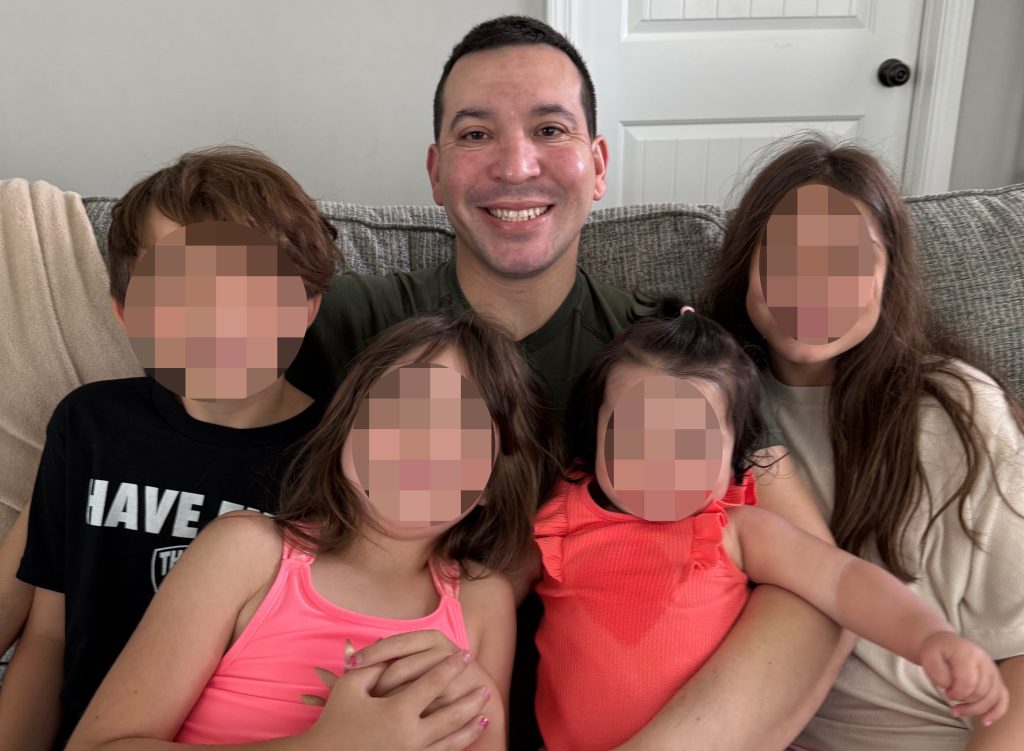
Yolanda convinced Damien to visit a neurologist after noticing a tremor in his right hand and that he was dragging his right foot.
Brain scans repeatedly pointed towards Huntington’s disease, yet Damien tested negative three separate times.
He was further tested for cancer, heavy metals and other genetic disorders, which also returned negative results.
A movement specialist eventually ordered a full genetic panel, which revealed Huntington Disease-Like 2.
By this point, Damien was already experiencing severe cognitive problems, and initially misunderstood his own diagnosis on the phone.

Yolanda said: “The first thing that went through Damien’s mind was that he was dying.
“Mine was the kids.
“My sweet babies were at risk.”
The couple told the children together, explaining that their father’s brain was “sick” and could make him angry, move more slowly or struggle to do certain things.
For now, Yolanda does not plan to have them tested.
She said: “I think it’s pretty typical in the Huntington’s community not to test children.

“They can’t fully understand the disease and what a positive result would mean.
“There are ethical concerns too.
“They’re the ones who would have to live with that knowledge, so they should be able to decide for themselves when they’re older whether they want to be tested.
“Not everyone wants to know, and some people may be too fragile for that knowledge.”
Yolanda manages Damien’s medication, prepares his meals, drives him to appointments and handles the family’s finances.
Alongside managing his care, Yolanda is determined to keep memories of the man he was alive for their children.

The couple have been told Damien’s life expectancy could be between 10 and 20 years from the onset of symptoms.
Damien was officially diagnosed in February 2025, following tests in November 2024.
She said: “Damien was so smart and annoyingly athletic.
“He was great at everything.
“Most importantly, he loved being a dad.

“I try to keep those memories alive for my kids.”
Yolanda is now speaking publicly in the hope that other families with Huntington’s-like symptoms are offered wider genetic testing.
She added: “I can’t help but wonder if there are more families like ours that tested negative for HD and think they are free from the disease.
“I hope that one day there are treatments or a cure.”
READ MORE: ‘I wore a bikini for the first time at 26 after £16,000 surgery fixed my missing chest muscles’