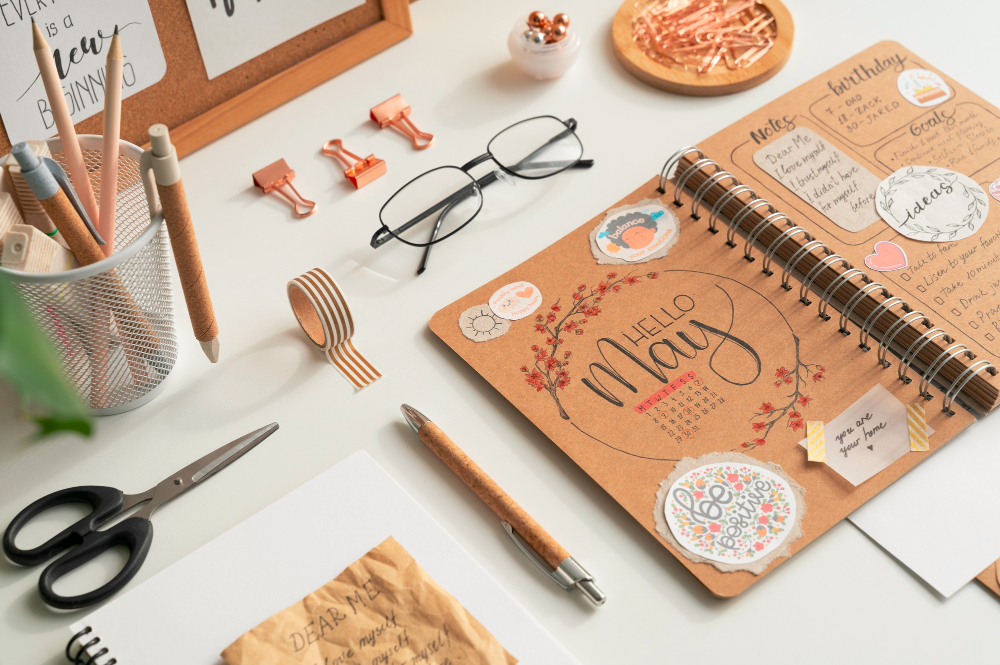

There is something subtly satisfying about opening a fresh notebook, uncapping a pen, and letting thoughts land on the page.
In a world that moves fast, journaling invites people to slow down. It does not demand perfection or productivity. It gives the writer a private space to do a quick brain dump, plan the week, or build a spread with colour, doodles, and sticky notes that keep the important things visible.
For many people, part of the joy is the stationery.
A journaling kit can turn writing into a small ritual. The right tools make daily journaling easier to begin, easier to maintain, and more enjoyable to return to. This guide covers a stationery setup that supports planning, reflection, and creative journaling, without needing a desk full of unused supplies.
Why stationery can support the journaling habit
The right stationery will not magically fix a schedule or remove stress, but it can make showing up feel simpler.
A pen that glides makes writing feel less like effort. A softer highlighter set helps a busy week look clearer at a glance. A strip of washi tape can separate sections and keep a page readable, especially when everything feels like it is happening at once.
For many creative professionals, journaling becomes more than a productivity habit. It becomes a thinking tool and a creative outlet that supports brainstorming, mood tracking, and everything from visual storytelling to memory keeping.
Finding a journaling style that fits
Buying stationery is easier when the journaling style is clear first. Most journaling routines fall into one main lane, or blend a couple depending on what the week looks like.
Bullet journaling for structure
bullet journaling suits planners and list-lovers. It is flexible, organised, and practical for tracking tasks, events and habits.
A beginner-friendly Bullet Journal setup stays simple: an index page, a future log, a monthly layout, and a weekly spread that prioritises function over decoration.
Art journaling for creative expression
Art journaling suits people who enjoy colour, textures, doodles, and creative freedom. In this style, stationery becomes a creative toolkit, with pens, markers, tapes, and small page elements that make the journal feel personal.
Gratitude and well-being journaling for calm and perspective
When life feels mentally loud, gratitude and well-being journaling can be a gentle starting point. A few lines a day can build reflection into a routine, without turning journaling into another task to “do perfectly.”
The essential journaling stationery kit
A useful kit balances practicality with creative options. The goal is to make it easy to write, plan, and decorate without creating clutter.
1) A reliable pen for everyday writing
Even in a world of trendy stationery, the classic Ballpoint Pen is still a staple. It writes quickly, lasts a long time, and typically resists smudging, which makes it ideal for fast notes and everyday planning.
For a smoother feel and stronger colour, many journalers add gel pens, but they can smudge on certain papers if the ink stays wet a fraction too long. brush pens are popular for headings and hand-lettering accents, but they can ghost through thinner pages, so they tend to shine most in sturdier notebooks.
2) Fine liners for clean layouts and trackers
For neat grids, tidy headings, and clear habit trackers, fine liners make a big difference. A popular choice is the STAEDTLER Triplus Fineliner, which suits structured layouts and small writing where precision matters.
3) Highlighters that bring clarity to a busy page
A good highlighter set helps readers find key tasks and appointments quickly. Many people choose Zebra Mildliners because softer tones keep pages readable while still adding colour and organisation.
4) Sticky notes for flexible planning
Sticky notes are practical for plans that change. They are useful for reminders, priority tasks, quick lists, and anything that needs to move without rewriting an entire page.
5) Washi tape for quick personality and structure
Washi tape adds warmth and structure without requiring artistic skill. It can divide sections, frame photos, decorate borders, or simply mark an important day so it stands out.
Choosing the right diary format
Not every journaler wants to create a layout from scratch. A pre-dated diary makes planning quicker, keeps the week organised, and removes the pressure to “design” pages before using them.
On OfficeStationery.co.uk, diaries are available in practical formats like A4 and A5 desk diaries, Quarto diaries, and Slim diaries, with popular layouts including week to view, day per page, and appointment pages.
A few strong examples for work and weekly planning include:
- Weekly Spread Diary style (week to view): 5 Star Desk Diary Week To View A5 Black 2026
- Appointment layout (ideal for meeting-heavy schedules): 5 Star Desk Diary Day Per Page Appointment A4 Black 2026
- Two days per page (extra space without a full page per day): 5 Star Desk Diary 2 Day Per Page A4 Burgundy 2026
- Slim diary (compact for commuting and on-the-go planning): 5 Star Slim Desk Diary Portrait Week To View Black 2026
Lifestyle-led formats like My Journal Weekly Diary and Goal Digger Diary often describe the style of planning people want. In office diary ranges, the closest match usually comes down to layout choice: week-to-view for a clean weekly overview, or appointment pages for busier schedules.
Extras that make journaling smoother
A few add-ons can make the habit easier to keep, especially for people who journal between meetings or on the move.
An A5 Notebook Band keeps pages secure in a bag and helps prevent curling. A Pen Case stops favourite tools from disappearing into the bottom of a tote. A stationery box keeps supplies tidy, which makes it easier to sit down and start instead of rummaging around for ten minutes.
The role of pencils in journaling
Pens and highlighters are not the only tools worth keeping. Pencils are ideal for drafting layouts, sketching, doodling, and shading details.
A mix of H pencils for lighter, cleaner lines and B pencils for darker, softer lines gives flexibility for planning and drawing, especially when a page needs to be mapped out before committing to ink.
Journaling ideas beyond planning
Once a kit is in place, journaling can expand into more creative and meaningful forms.
For memory keeping, adding photos, ticket stubs, postcards, and paper scraps turns a journal into a personal time capsule. For visual storytelling, combining small sketches, highlighted moments, weekly recaps, and colour-coded sections can capture life without long paragraphs.
For gratitude and well-being journaling, a simple structure often works best: three things to be grateful for, one small win, and one lesson or insight from the day.
Theme spreads can make planning more enjoyable. Many people experiment with colour palettes, seasonal motifs, and small decorative touches using gel pens, brush pens, washi tape, Zebra Mildliners, and sticky notes.
A gentle reminder about journaling
A journal does not need to look perfect. Some weeks will be highly organised. Other weeks will be quick notes and simple lists. Both are valid.
Stationery is meant to support the habit, not create pressure. The goal is simply to begin and keep going.
One page at a time.