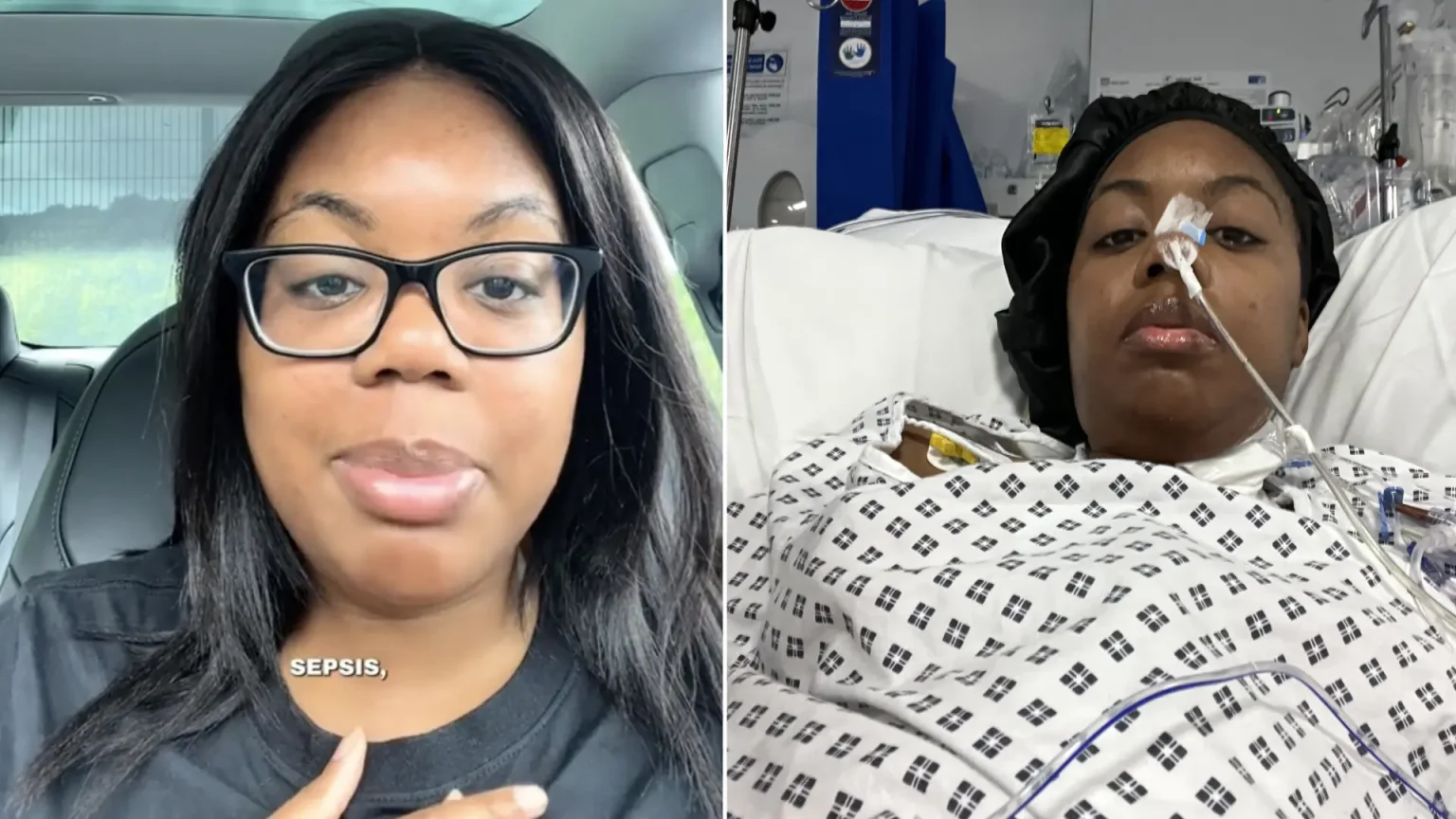

A woman who was told her symptoms could be linked to stress claims she nearly died after a ruptured ovarian cyst triggered sepsis.
Olamide Ogunseye spent three weeks in hospital and underwent emergency surgery after what began as seemingly minor changes to her menstrual cycle spiralled into a life-threatening ordeal.
As well as a ruptured ovarian cyst, doctors discovered a bowel obstruction had left part of the 36-year-old’s intestine wrapped around a fallopian tube.
READ MORE: ‘I had postpartum depression as a DAD – and felt nothing when my baby was born’
The first sign that something was wrong came when Olamide began having periods every 14 days.
A month later, she visited her GP, who suggested the symptoms could be linked to stress following a relationship break-up, a friendship ending and redundancy.
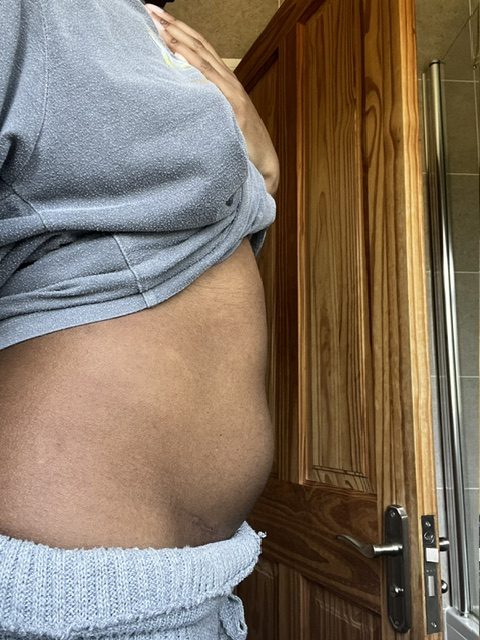
“As the weeks went by, my stomach became really bloated and visibly bigger,” Olamide, from Surrey, told Need To Know.
“At the time, I was a comfortable UK size six, so when my trousers became tight and I had to unzip them just to sit down, I knew something had changed.

“I went to the GP, explained my symptoms, and was examined.
“She told me that if things persisted, she would refer me to the hospital.
“At the beginning, I didn’t think much of it.
“I had four periods in two months and knew something wasn’t right.
“The GP I saw, someone I’d never met before, asked whether anything major had happened in my life recently.
“I’d gone through a relationship breakup, a friendship breakup, and about three weeks later had been made redundant.
“She suggested the stress could be throwing my cycle off.
“I understood why she said that, but something didn’t sit right with me, because I genuinely wasn’t stressed.
“Everything that had happened had happened for a reason, and as things unravelled, I’d come to peace with all of it.
“That belief kept me grounded but by that fourth time, I knew intuitively that something was wrong and no amount of reassurance was going to convince me otherwise.”
Olamide’s symptoms first appeared in March 2023 and continued to worsen.
By June, she was struggling to stand for long periods and, during a work meeting, was struck by a sharp pain in the centre of her abdomen.
Initially convinced it was severe period pain, she went home to rest.
But when she woke up hours later, vomiting and in agony, she called NHS 111 and made her own way to hospital.
She said: “I was told no ambulance could be dispatched and that I would need to wait up to seven hours as I was still conscious and breathing.
“Shortly after the call, I passed out from the pain briefly and came round.
“I made my way to Croydon University Hospital at around 9:30pm.”
Doctors quickly realised something was seriously wrong.
Olamide, an entrepreneur, said: “By then I was vomiting bile, I filled one sick bowl to the brim and was handed a second.
“My blood pressure was dangerously high, my temperature was in the forties, and my blood results showed a very high white blood cell count, all while I was still vomiting.
“I had undergone an MRI, a CT angiogram, a transvaginal ultrasound, and a standard ultrasound, alongside four-hourly blood pressure checks, temperature readings, and blood tests.
“The results consistently showed a significant infection.
“Honestly, I was so exhausted I could barely process what was being said.
“I just had to trust I was in the right hands.”
Doctors eventually discovered that, alongside a ruptured ovarian cyst that had triggered sepsis, Olamide had an internal hernia.
They believe a weakness in her abdominal wall, possibly linked to a previous fibroid removal operation, allowed part of her small intestine to move out of position.
The displaced bowel then wrapped tightly around one of her fallopian tubes, creating a dangerous bowel obstruction.
On 9 June, surgeons initially attempted keyhole surgery but her bowel was accidentally punctured, forcing doctors to convert the procedure into major open surgery.
They repaired the puncture, removed between 10cm and 15cm of damaged small intestine and carried out a full abdominal washout after discovering pus from the ruptured cyst had spread throughout her abdominal cavity.
When Olamide regained consciousness, she found herself in intensive care.
She said: “I was in hospital for a total of three weeks.
“Not many people around me knew what was happening; everything was so intense, and I was on strong painkillers like fentanyl and morphine for much of it, so I was quite drowsy and sleepy for the most part.
“My workplace was aware and was so shocked at how quickly things had escalated, from stomach pains to being in ICU.
“My belief in god, the universe, that I was going to be OK, also kept me grounded throughout.
“I’d been through something similar before with my fibroid removal, but that was fully planned; I had months to prepare myself mentally.
“This happened so suddenly and so severely that there was no time to process it.
“I just had to get through it.
“I couldn’t believe how quickly things had escalated.
“I remember waking up in ICU after the surgery feeling completely confused, I had been told it was going to be keyhole, so in my head I was hoping to be discharged the next day at the latest.
“Waking up to the reality of where I was and what had actually happened, I was emotional and utterly shocked.
“I remember thinking, ‘am I dreaming?’.
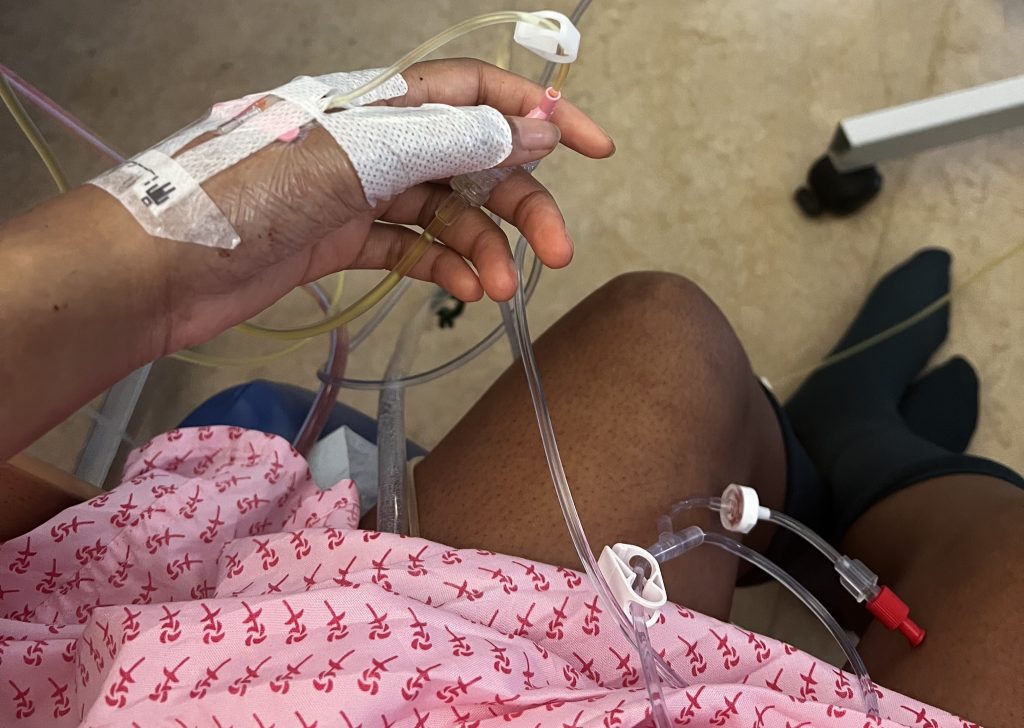
“There were so many tubes hooked up to me.
“Honestly, for about a week, none of it felt real.”
Olamide says the emotional impact of the ordeal was just as significant as the physical recovery.
She said: “The first two weeks I cried every single day, but these tears were coming from a different place.
“I felt so vulnerable.
“In those early days, just getting out of the hospital bed was an achievement.
“Still attached to wires and tubes, I pushed myself to stand and move to the chair beside my bed.
“It took every bit of strength I had and had to be done in stages.
“A couple of weeks in, my mum would encourage me to walk up and down the small bay area where my bed was, just to get some movement rather than sitting in one position all day.
“It was so painful with the incisions, and it honestly took around 30 minutes just to walk the length of a six-bed bay.
“After the surgery, I had to sleep on my back for at least a year and a half.”
She remained off work for three months and spent the following 18 months attending regular surgical follow-up appointments.
Thankfully, Olamide has now made a full recovery.
She added: “The recovery was slow and long, but being back at home made an enormous difference.
“I remember hugging the bannister as I walked through the front door; just being home felt like a milestone.
“I missed feeling like myself. My dressings needed changing every couple of days, which was uncomfortable and a constant reminder of what my body had been through.
“I also had to relearn eating three meals a day, having been nil by mouth for so long, though I’ll never forget my mum sneaking me an ice cream.”
Olamide is sharing her story to encourage women with similar symptoms to push for answers.

She added: “I want women to know to push for answers and not dismiss what their body is telling them.
“Every so often we hear stories of people who die from sepsis or a bowel obstruction and I had both.
“I share my story because awareness is everything.
“If even one person feels empowered to push back, to stand their ground, to trust what their body is telling them, then my story is worth telling.
“Sepsis and bowel obstructions are serious.
“They can escalate from manageable to life-threatening faster than most people realise, and the window to act is narrow.
“From the second time my period came within 14 days to the night I ended up in ICU was roughly two months. T
“There should have been a far greater level of concern at that very first GP appointment; instead, I was told I was stressed.
“I understand the pressures on the NHS, but dismissed symptoms have consequences, and sometimes those consequences are fatal.
“I’m back to perfect health now and I am truly grateful for that.
“Countless women right now are not being heard when it comes to conditions like fibroids, endometriosis, and PMOS, formerly known as PCOS.
“Women’s health deserves to be taken seriously, every single time, not just when it reaches crisis point.”
READ MORE: Miracle boy, 7, defies 1% survival odds after ‘drunk driver’ crash left him ‘dead’ for 10 MINUTES